Teacher Observation FAQs
If a teacher instructs more than one TIA-eligible course, does the teacher observation have to take place in the same course that the teacher is being submitted for a designation?
The minimum requirement is a 45-minute observation for each teacher in an eligible teaching assignment. There is no TIA rule requirement that the observation must align with the course submitted for designation in the event that a teacher teaches multiple courses. However, it is best practice for the T-TESS observation to align with the course being submitted for designation for the purpose of analyzing correlation data. When the student growth measure and the T-TESS observation do not align with the same course, districts should consider the impact on their correlation data.
Should ratings collected during calibration protocols be used as formal ratings?
While the decision is entirely up to the school, the ratings collected during a calibration activity are likely to be accurate since each rating was agreed upon by more than one person. For that reason, we recommend using these as formal ratings if that makes sense for your district or school. As you decide, be sure to solicit teacher input.
If two appraisers disagree about a rating, how do we decide which rating is the most valid?
Using evidence collected during the observation, appraisers should discuss which rating makes the most sense based on the teacher observation rubric and then come to a consensus. The practice of debating and grounding discussion in evidence is perhaps the most important part of calibration activities because it promotes a deeper understanding of how to appraise instruction using the rubric. When in doubt, rely on scripted evidence.
What should we do if appraisers don’t calibrate to each other during a calibration activity?
During a single calibration activity, districts should not be concerned if appraisers aren’t calibrated. Continue engaging in calibration activities to become increasingly aligned over time. If a trend emerges in which appraisers or campuses are consistently not calibrated, the district and/or campus should create a plan to increase appraiser validity and reliability. Next steps could include the following:
- Re-train appraiser(s) on the district’s teacher observation rubric.
- Norm on what constitutes each performance level on the rubric for a specific subject or grade level.
- Until calibration is established or re-established, two appraisers conduct each scored observation.
- Assign each teacher two appraisers and use the average scores of both appraisers.
- Increase individualized coaching of appraisers who are not highly calibrated.
Many districts allow eligible teachers to waive an annual appraisal. Will an annual appraisal be required for teachers to earn a designation?
Districts must have observation and student data from the data capture year for all teachers in the district’s system. After receiving full system approval, districts may have teachers on appraisal waivers, but those teachers may not be submitted for proposed designations. An annual appraisal is required for teachers to earn a designation. TEA cautions districts to use waivers sparingly following system approval, as this may impact future data validation and future proposed designations. Appraisals must comply with §21.351 and §21.352.
General FAQ
What is TIA?
The Teacher Incentive Allotment (TIA) is a program that provides top-performing teachers an accessible pathway to a six-figure salary without having to leave the classroom. When a teacher earns a designation through their district’s local designation system, or holds a National Board Certification, the designated teacher generates extra funding for their district.
How do I contact a TIA team member?
The TIA Team provides training, ensures districts are well-supported throughout the process of developing and implementing a local designation system, and are available to answer questions. For questions, contact the team at tia@tea.texas.gov.
Where does TIA funding come from?
TIA funding was built into Texas state law as part of House Bill 3 during the 86th Texas Legislature. It is a Tier 1 allotment through the Foundation School Program (FSP), the system through which the state provides funding to districts. This system, grounded in the Texas Education Code, creates a sustainable funding source for districts implementing TIA.
Why should a district consider developing a local designation system?
By implementing a local designation system, districts are able to better support their teachers and their students. These systems will prioritize teacher learning and student outcomes; connect to campus and district best practices; incentivize teachers to stay; support more robust recruitment; and make the educator profession more desirable.
Developing and Applying for a Local Designation System
What adjustments can we make to the Weighting tab from our accepted System Application?
Districts can make the following modifications from their accepted System of Record:
- Change the weighting of approved components. (e.g., the district’s System of Record weighted teacher observation at 30% and student growth at 70%. The district could change the weighting to 50/50.)
- Combine teaching assignments into a single category if using the same weighting and student growth measures. (e.g., district’s System of Record listed 3-5 MAP and 6-8 MAP as separate teaching categories, although they use the same student growth measure and weighting. These can be combined into one category in the Weighting tab.)
- Remove other optional, non-statutory components. (e.g., attendance, student surveys.)
Districts may NOT:
- Add or remove new eligible teaching assignments.
- Add or remove student growth measures.
- Add or remove teacher observation rubrics.
- Exclude teacher observation or student growth when determining designations.
- Exclude one or more eligible teacher groups.
Our district uses multiple growth measures and/or conducts more than one scored observation. How do we report multiple scores?
Each teacher in the data file should have one observation score for each dimension and one student growth score. Determining the final score will be a local decision, and the district must report how observation and growth was determined (i.e., higher of two scores, averaged, weighted values for each year) in the District Information tab. Districts may report observation scores with decimals if averaging or weighting multiple observations. Student growth scores must be reported as percentages without decimal points.
Should uncertified teachers be included in the data submission file?
Yes. Uncertified teachers working in eligible assignments must be included in the district’s data capture and data submission. As of 2021, uncertified teachers may earn designations. Some districts have a local prerequisite that limits designations to certified teachers, but they must still collect and report data for uncertified teachers in eligible assignments.
How should the TIA lead be determined?
The TIA lead must have the expertise, capacity, and high-level support to lead the work. While some districts may create a position specific to leading their TIA local designation system development, most designate existing personnel to lead TIA while performing other essential functions. The TIA lead should have regular access to district leadership when key decisions are made.
District TIA leads often work in human resources, teacher appraisal, or curriculum and instruction. A best practice for larger districts is to select two or more TIA leads working in different departments.
What happens if a TIA lead leaves the district?
If the TIA lead retires, resigns, or moves into a new role, districts may update their contact information by emailing TIA@tea.texas.gov. TEA encourages districts to have at least one back-up point of contact who is aware of the district’s TIA plans and can access documentation.
Learn more about the role of a TIA Lead.
How can districts include Special Education teachers in the local designation system?
Some districts choose to begin with a subset of teaching assignments or campuses and then create plans to expand their system after initial approval. As district teams build their local designation system, they can include support teachers such as interventionists, SPED inclusion, and dyslexia teachers if they are employed as a teacher (087 StaffClassification (formerly Role ID) in PEIMS) and have a valid and reliable student growth measure.
Review this resource to learn more about integrating Special Education teachers in the TIA local designation system: TIA Special Education
Can a district phase in groups of teachers over time?
Yes. Districts have local flexibility to develop their local designation systems. For example, a district may choose to include only math and reading teachers in year one, and then expand to include science and social studies teachers in year two, etc. Districts must submit an expansions/modifications application by April for changes to begin capturing data for new teacher groups the following school year.
Can a district apply for TIA only at specific campuses in its district and not others?
Yes. Districts must specify which campuses are eligible under their local designation system and are not required to include all campuses. However, the district may still receive funds for designated teachers employed at campuses that are not included in their local designation system.
Can 1882 partners apply for a local designation system?
Yes, 1882 partners may apply for their own local designation system with sign off from the parent district superintendent. All funds are awarded to the district. 1882 partners and their districts must work together to ensure that funding for teachers employed by the partner is transferred and spent in compliance with statutory requirements. 1882 partners should apply and develop unique systems for each of their district partnerships.
In some cases, the district includes 1882 partner-operated campuses in their local designation system and collaborates with the partner to ensure the system is implemented with fidelity.
Can interventionalists or inclusion teachers be included in the local designation system?
It is a district decision whether or not to include support teachers in the local designation system. TEA does not limit eligibility to teachers of record. Teachers must be coded with a 087 teacher StaffClassification (formerly Role ID) in PEIMS to be eligible.
What is the time frame to apply, and what happens after a district’s local designation system is submitted for review?
Districts must submit a completed application by April to begin implementing their accepted system and gathering teacher performance data the following school year. TEA reviews system applications and notifies districts by late July whether the application was accepted.
When should districts begin communicating with teachers about their local designation systems?
Districts are encouraged to communicate with teachers early in the process and throughout the development and implementation of their local designation systems. The TIA Readiness Checklist includes a section on community and teacher communication.
What student growth measures can be used for teachers in non-tested subjects?
Districts can use locally developed or third-party student growth measures, as long as they are valid and reliable. Examples include SLOs, pre- and post-tests, industry certification exams, and student portfolios. Districts may find the T-TESS Guidance on Student Growth Measures (PDF) helpful as they consider different student growth measures. For more information, visit texasslo.org.
Can the district utilize existing student growth measures for the local designation system?
Districts may begin by looking at the student growth measures already in place for each assignment and exploring which assignments may require a new or modified option.
The timeline for implementing new student growth measures is often a top consideration when determining eligible teaching assignments and readiness to apply for a local designation system. Districts can opt to start with teaching assignments which already have valid and reliable growth measures while exploring student growth measures for additional teaching assignments in subsequent years.
Is TIA limited to Teachers of Record?
TEA does not limit designations to teachers of record. Districts may also include support teachers such as interventionists, SPED inclusion, and dyslexia teachers if they are employed as a teacher (087 StaffClassification (formerly Role ID) in PEIMS), are appraised using an approved rubric, and have a valid and reliable student growth measure.
Funding & Spending Plans
What deductions can be taken from teacher payouts?
Like other income, TIA teacher payouts may be subject to taxes and retirement contributions. All compensation from TIA is TRS eligible. Districts may pay employee and employer contributions from the 90% portion of the allotment or from the 10%, as those benefit payments are considered to be included in overall compensation. See our TIA Guidance for District Business Offices for more details around how districts can issue payouts.
Will the agency monitor district compliance?
The agency utilizes authority found in TEC §48.004, §48.270, and §48.272 to audit districts in their compliance with Texas Education Code and Texas Administrative Code.
How can districts use the allotted funds?
Districts must spend at least 90% of the allotment on teacher compensation on the campus of the designated teacher, while up to 10% can be used to support the local designation system.
Within these parameters, districts may choose to split the allotment funding in several ways. Some districts choose to give the full 100% of funding to their designated teachers. Other districts choose to split the funding to reward other eligible educators who contribute to student success, such as instructional paraprofessionals.
Districts may use funds from the 10% to provide additional professional development opportunities to designated teachers and teachers who may be eligible for designation in the future.
Learn more about how districts are allowed to use the allotted funds.
What is an example of a TIA stipend plan?
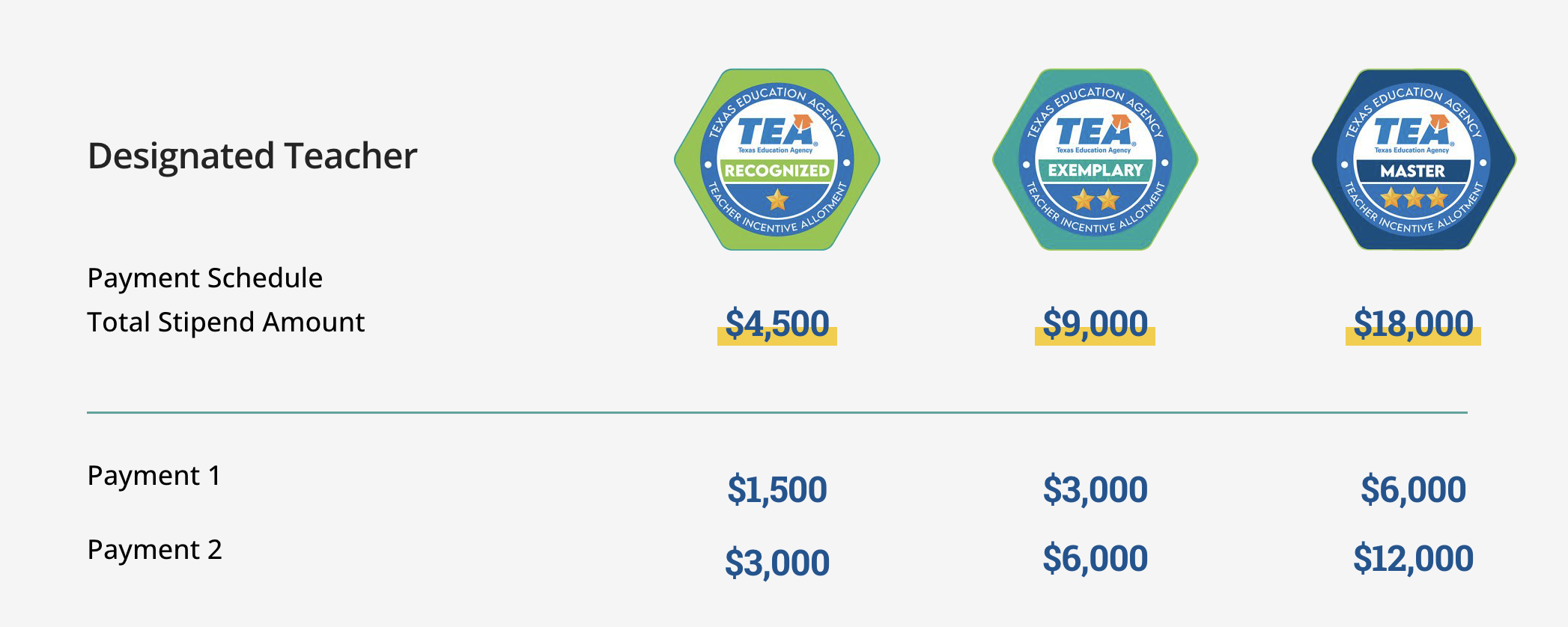
In this example, the stipends are paid out in two payments, with a larger final stipend paid in August as a retention bonus for those educators returning to the school.
What is an example of a TIA salary raise plan?
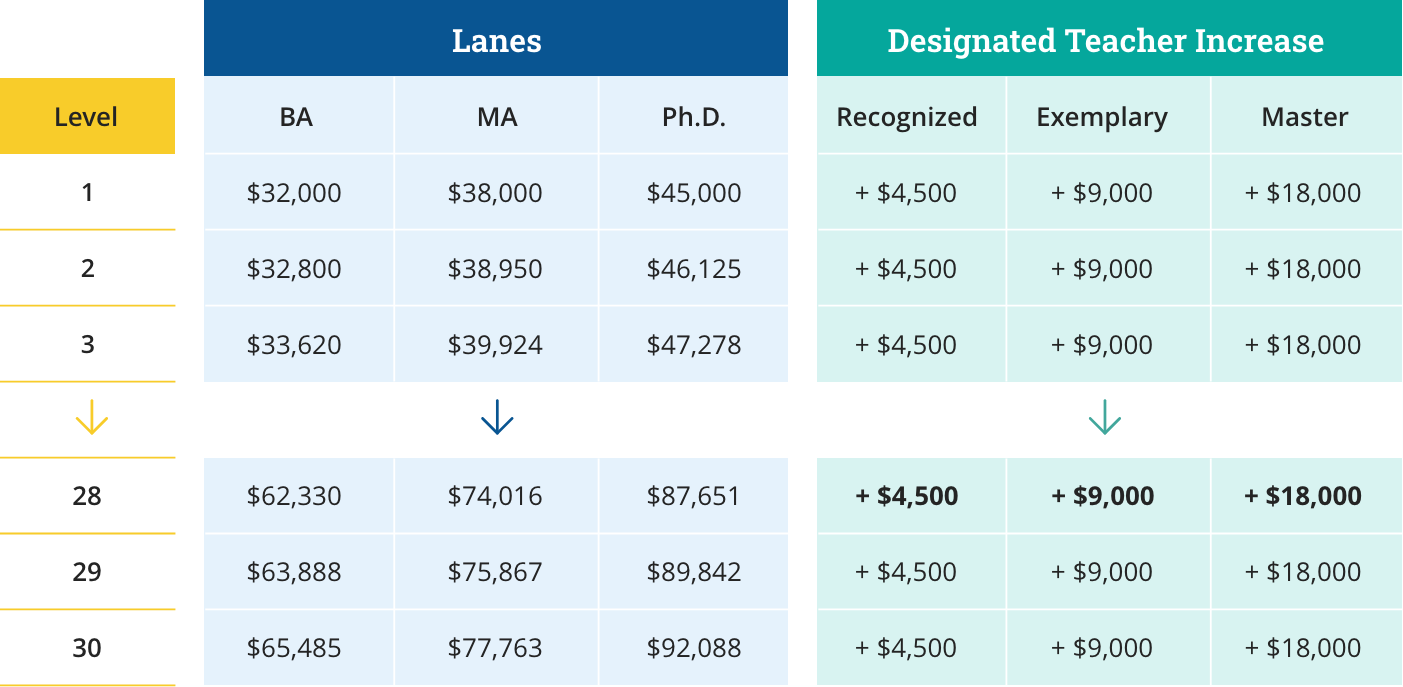
In this example the TIA performance raise for designated teachers is created by adding lanes to the district’s standard teacher salary schedule. The amounts in the Recognized, Exemplary, and Master lanes are added to the designated teacher’s salary based on where they fall within the standard steps and lanes.
What is an example of a TIA combination plan?
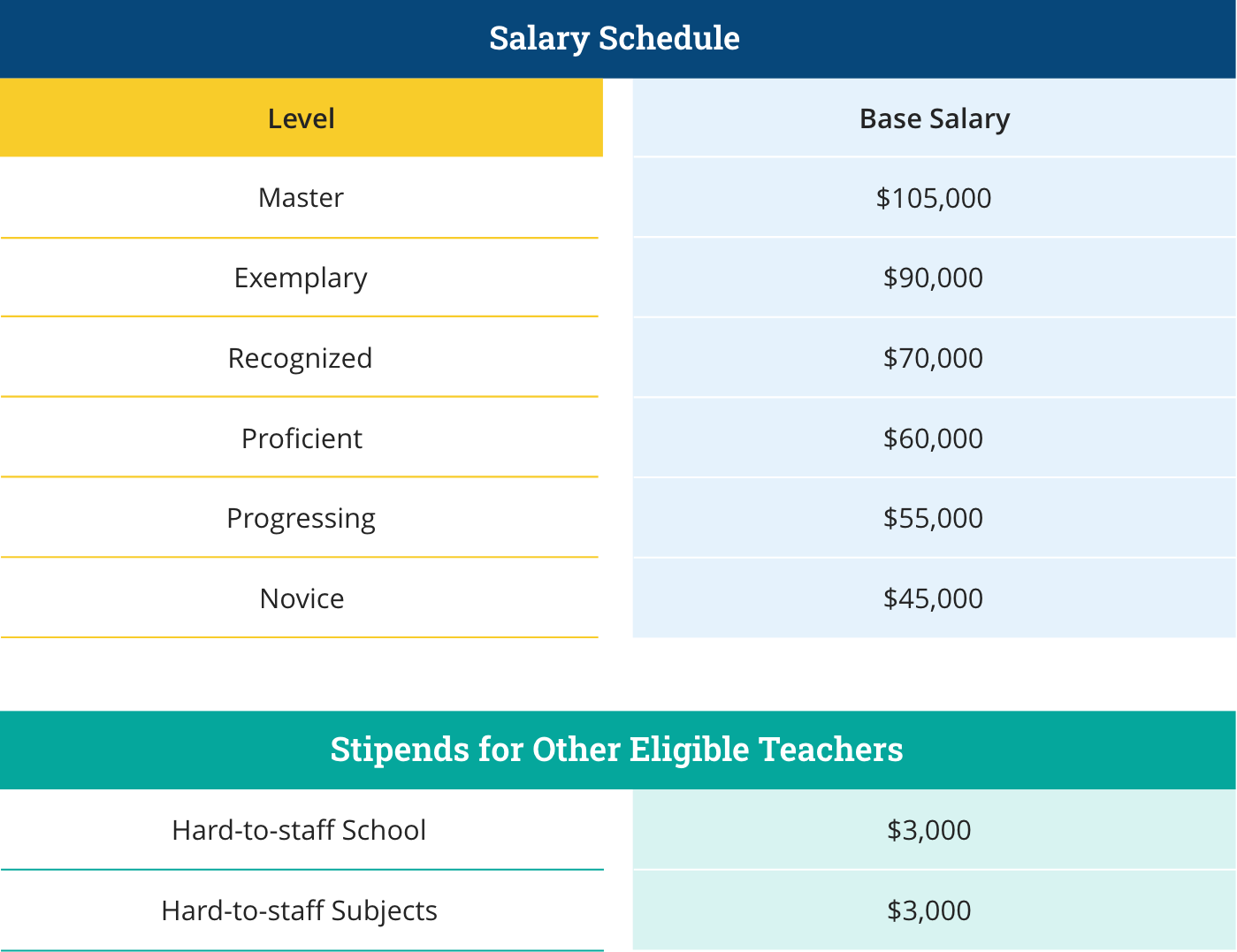
This example uses a salary schedule ranging from Novice for new teachers to Master for the highest performing teachers. It includes stipends of $3,000 as an incentive for teachers to work in hard-to-staff schools and hard-to-staff subject areas.
How do districts manage allotments if designated teachers leave?
Districts need a plan for teachers who resign prior to the scheduled payout date. Some districts may choose to forward the full or remaining payment to the designated teacher. Other districts may choose to use the funds to compensate teachers who remain on the campus. All funds must be spent by August 31.
Is the allotment for the teacher or the campus?
Funding for teachers designated as Recognized, Exemplary, and Master under TIA are awarded to districts, which in turn must spend at least 90% of the funds on teacher compensation on the campuses where the designated teachers work.
TEC Section 48.112 (i)(1)(A): A district shall annually certify that funds received under this section were used as follows: At least 90% of each allotment received was used for the compensation of teachers employed at the campus at which the teacher for whom the district received the allotment is employed.
What is the timeline for receiving TIA funds?
For the first year of a teacher’s designation, districts are notified of funding amounts by designation level and campus in the spring, and funds arrive the following September in settle-up. Following the initial payment, districts receive regular funds based on projections according to their regular FSP payment schedule, with settle-up each September.
Will there be spending codes for TIA funds?
There are no PIC codes for TIA funds. Funding and reimbursement of fees are a separate line item in FSP payments.
Will the campus socioeconomic tier data be recalculated every year?
Yes. Given that a school’s student enrollment changes yearly, the campus’ socioeconomic tier is recalculated annually. As a reminder, this calculation uses the home addresses of students who attend a particular campus. Allotment funds for each designated teacher are based on the campus, and not the individual students assigned to the designated teacher.
If a designated teacher moves campuses from one school year to the next, will the allotment that teacher generates be recalculated? What if a teacher leaves in the middle of the year?
While designations are tied to the teacher and not their employing district or campus, allotment funds are awarded to the district where the teacher was employed as of the last Friday in February. For teachers who meet eligibility criteria, the district employing the teacher as of the last Friday in February will receive funds for that school year and must spend the allotment funds by August 31. The percentage of allotment awarded to the designated teacher varies by district. Districts are not required to forward funds if the teacher resigns or retires before August 31. If a designated teacher moves to a new district or campus between school years, the allotment for the next school year will be recalculated in April based on the new campus’ rural status and level of socioeconomic need.
If a district does not have a local designation system as part of the Teacher Incentive Allotment, but employs designated teachers, will the district receive allotment funds for those teachers?
Yes. Districts that employ teachers who have earned designations will receive funding for those teachers based on the TIA formula, even if the district does not have an approved designation system in place.
For example, a district that does not have a designation system in place could employ a teacher that earned a designation in another district or a teacher who automatically earned a Recognized designation for having achieved National Board Certification. Districts need to develop a plan for how to spend allotment dollars that they receive, in accordance with the statutory requirements.
System Implementation
What if a teacher works in more than one eligible teaching assignment?
Districts may use data from one or multiple eligible teaching assignments in the same eligible teacher category. This is a local decision.
How will TEA know if Student Learning Objectives (SLOs) are measuring growth effectively?
The application for a local designation system requires districts to explain in detail their procedures and protocols for SLO implementation, including procedures for setting student preparedness levels at the beginning of the year, protocols for collecting the body of evidence of student work, and rubrics/protocols used to approve SLOs at the end of the year. All districts must go through the data validation process before TEA determines full system approval.
Many districts allow eligible teachers to waive an annual appraisal. Will an annual appraisal be required for teachers to earn a designation?
Districts must have observation and student data from the data capture year for all teachers in the district’s system. After receiving full system approval, districts may have teachers on appraisal waivers, but those teachers may not be submitted for proposed designations. An annual appraisal is required for teachers to earn a designation. TEA cautions districts to use waivers sparingly following system approval, as this may impact future data validation and future proposed designations. Appraisals must comply with §21.351 and §21.352.
Once approved districts submit their data in the fall following their data capture year, will they be required to continue submitting data for the next four years?
Districts with a fully approved local designation system can submit data each year they wish to put forth teachers for new or higher designations, however, Texas Tech will still perform annual data validation. It is possible that a district’s designations will not be approved for one or more of the five years if the data no longer reflects a valid and reliable system.
What data will schools be required to submit for the data validation process?
Each teacher in the data file should have one observation score for each dimension and one student growth score. Determining the final score will be a local decision, and the district must report how observation and growth was determined (i.e., higher of two scores, averaged, weighted values for each year) in the District Information tab. Districts may report observation scores with decimals if averaging or weighting multiple observations. Student growth scores must be reported as percentages without decimal points.
Read more about data submission and validation.
Will districts have to submit data every year?
Districts submit data for all teachers in eligible teaching assignments each year that they put forth new teachers for designation.
If a system is not approved, can the district resubmit data the following year?
Systems that fail to pass data validation may resubmit the following year.
Designation Policies
Can students be assigned to a teacher pending designation and meet accelerated instruction requirements under HB 1416?
No. TEC, Sec. 28.0211 requires assignment of the applicable student to a TIA designated teacher or to a program of supplemental instruction. If a teacher is not yet designated at the time of the student’s assignment, then supplemental instruction is needed.
What if a teacher is missing observation and/or student growth data? For example, they waived their appraisal, resigned, or retired before the end of the school year.
Teachers who do not have complete observation and student growth data should not be included in the data file. On the District Information tab, in the Teacher Discrepancy section, please outline any discrepancies in the number of staff reported in eligible assignments compared to the number of teachers reported in the data file.
If I select “No designation” for a previously designated teacher on the submission file’s Data Entry tab, does that affect their current designation status?
No, selecting “No designation” in column J for Proposed Designation Level for a teacher that has been designated in prior years will not affect the status of their current designation.
Can teachers who move to a non-eligible teaching assignment or move campuses in 2025-26 year still earn a designation?
Yes. TEA will only verify assignment eligibility for the 2024-25 Data Capture Year. For 2025-26, TEA will verify that the teacher is still employed as a teacher (087 role ID) and meets the creditable year of service requirement before issuing a designation.
What if we discover an error in our data or teacher designations after the data submission deadline has passed and our file has been accepted?
Once the data submission file has been accepted, it is considered final. Therefore, districts will not be able to add or remove teachers, change teacher designations, or edit performance data. This policy is guided by state statute that requires TEA to validate district systems. For further details, please see the explanation below:
- Texas Education Code requires TEA to establish performance and validity standards to ensure that district TIA systems meet requirements for system implementation.
- The agency has an established timeline and procedure to collect proposed designations from districts and to then validate districts’ system for designating teachers. Based on the validation process, proposed teacher designations are accepted. In some cases, districts do not meet validity standards, and the proposed designations are not accepted.
- Because of the timelines required for data analysis, we cannot accept changes to proposed designations, like adding teachers to the designation list, after the file is accepted and the data validation process has started.
Who is eligible to earn a designation through a local designation system?
Teachers employed in eligible teaching assignments may be submitted for designation based on the prior school year’s performance data. Districts may submit teachers for designation if they meet the following criteria:
- Still employed by the designating district in a teaching role
- Meets the district’s performance criteria for designation based on teacher observation and student growth data from the prior school year
- Minimum observation score of Proficient in each observable dimension in the prior school year
TEA will conduct additional eligibility checks prior to awarding designations.
What if a designated teacher moves to a non-teaching role, such as instructional coach, counselor, or administrator?
Designated teachers who move to a StaffClassification (formerly Role ID) other than 087 will maintain their designation. However they will not generate annual allotment funding if they are not in a 087 teaching role. Teachers who move to a non-teaching position prior to formally earning a designation relinquish eligibility.
Are designations attached to a particular grade level or subject area?
Unlike certificates, designations are general. The designation is placed on the teacher’s SBEC certificate and does not specify a certification area, subject, or grade level. A teacher may change teaching assignments and will still generate allotment funding. The same applies to National Board Certified Teachers (NBCTs).
What if a designated teacher’s performance level changes within the five-year period? Can their designation level change?
Teacher designations are valid for five years. Within the five-year period, teachers may be put forth for a higher designation if their performance qualifies them, but they cannot be submitted for a lower designation. Some district spending plans may include variability based on continued performance levels.
What happens after the five-year designation expires?
Designated teachers who meet performance standards and district qualifications can be put forth for a new designation in the fall after the designation expires. The new designation will be retroactive to the beginning of the school year. Once the designation expires, it will be removed from the SBEC certificate (if applicable) and allotment funding will no longer be generated.
System Renewal
Does a district’s plan to expand or modify the local designation system at the time of renewal require a separate, additional Expansion and Modification Application?
No. The completion of the Renewal Application supplants the need for a separate Expansion and Modification Application in the same year.
If a district has submitted an Expansion and Modification Application since their initial System Application, do they still need to apply for renewal?
Yes. All districts that received initial system approval must submit a renewal application to continue to operate an approved TIA system. Districts are encouraged to access and complete the renewal application as early as possible in the required renewal year to ensure the application deadline can be met.
Can districts with an approved system submit an early Renewal Application?
No. Districts will be notified directly when renewal applications are required and should plan on renewing in the fourth year after the approved system application.
What happens if a district does not apply, or is not approved, for renewal?
Districts can designate teachers in the last school year of their five-year system approval period based on the previously approved system. However, the district’s prior approved system would expire and would not be eligible to designate teachers in the following school year.
National Board Certification
What is National Board Certification?
National Board Certification is a voluntary, advanced professional certification for PreK–12 educators that identifies teaching expertise through a performance-based, peer-reviewed assessment. More than 125,000 teachers across all 50 states have achieved Board Certification.
What is required to become a National Board Certified Teacher?
The certification process is designed to collect standards-based evidence of accomplished practice. To become a Board-certified teacher, eligible candidates must demonstrate advanced knowledge, skills and practice in their individual certificate areas by completing four components. The content knowledge component is a computer-based assessment taken at a testing center; the other three are portfolio-based and submitted through an electronic portfolio system.
Component 1: Content Knowledge
Component 2: Differentiation in Instruction
Component 3: Teaching Practice and Learning Environment
Component 4: Effective and Reflective Practitioner
What if a National Board Certified Teacher works in a district that is not participating in TIA?
Districts are not required to have a local designation plan to receive funding for Recognized NBCTs or seek reimbursement of eligible fees paid to the National Board. Eligible NBCTs earn a Recognized designation and generate annual allotment funding regardless of their district participation in TIA. Districts receiving TIA funds for NBCTs are required to abide by the spending requirements outlined in statute: 90% of allotment funds must be spent on teacher compensation on the campus where the designated teacher works.
NIET EE PASS FAQ
How can my district gain free access to the NIET EE PASS?
Districts must fill out the form above to access the resource library. Districts will be prompted to provide information for the individuals requesting access to ensure accounts are generated accurately.
Questions about registration access should email support@niet.org.
Once my district has a login, what will I find in the NIET EE PASS resource library?
The resource library contains four types of resources for districts to use: Video Library, Conference Archives, Training Modules, and Document Library. The video library contains split-screen videos of teachers & students and the scores, and evidence aligned to the Texas Teacher Evaluation & Support System (T-TESS) rubric indicators and/or the NIET TAP rubric, where applicable.
What if my district does not use the NIET TAP or T-TESS rubrics in our local appraisal system?
Districts for all approved appraisal systems can leverage the resources in the NIET EE PASS resource library. However, districts using locally developed, Marzano, or Danielson rubrics would need to align the video resources to rubrics and indicators, as these would not be provided for all videos.
Who do I contact if I have questions about the NIET EE PASS resource library?
Once logged into the portal, users should contact NIET directly using the “Contact Us” function.
Reports & Updates
Legislative Updates
Legislative Update: Teacher Incentive Allotment (TIA) Impacts
TIA Annual Report
Texas Administrative Code (TAC)
Teacher Designation: Acknowledged
What is the timeline for the new Acknowledged category and increased payouts?
Districts will be able to propose teachers for the Acknowledged designation in October 2026 using teacher performance data from the 2025-26 school year. To potentially qualify for the new Acknowledged level designation, teachers must have a full appraisal and student growth data in 2025-26.
Districts will receive an increased allotment for Acknowledged teachers and increased payouts in 2026-27.
Will TEA publish performance standards for the new Acknowledged designation?
Yes, TEA plans to share preliminary performance standard information in fall 2025 to inform district’s planning and TIA implementation. TEA anticipates the Acknowledged designation performance standards will be aligned with the top 50% of teachers statewide.
What is Enhanced TIA? Is it open to all districts?
This is a new district-level designation for districts with fully approved local designation systems that include all teachers and made strategic updates to salary schedules for teachers and campus administrators based on performance. Districts who earn this designation are entitled to their annual TIA teacher-generated allotment + 10%. TEA will release more detailed information in the coming months.
What are the implications of House Bill 2 for National Board Certified Teachers?
In 2026-27, National Board Certified Teachers currently designated as Recognized will be redesignated as “Nationally Board Certified”, and a new funding band will take effect. Nationally Board Certified teacher allotments will align with the Acknowledged designation level allotment. National Board Certified teachers will continue to be eligible for all levels of designation under a district local designation system.
To promote alignment with Texas standards and processes, HB 2 also creates a review process for National Board certification to determine future eligibility for TIA.
What is strategic compensation, and what is its relationship to Enhanced TIA?
Strategic compensation is a performance-based human resource management technique that involves designing and implementing a compensation plan that is strategically aligned with district objectives and culture.
In Texas, strategic compensation refers to developing a specific plan that allows districts to measure and reward employee effectiveness based on identified characteristics. This definition of effectiveness is then utilized to develop a salary schedule based on performance instead of basing compensation on years of service.
In 2025, the Texas Legislature created Enhanced TIA, a district-level designation for school systems that want to go beyond TIA. Districts can apply for and receive an Enhanced TIA designation after establishing a compensation system based on performance and other requirements. Once obtained, this designation allows districts to receive a 10% increase in their TIA allotment.
STAAR
What is STAAR Progress Measure?
The STAAR Progress Measure provides information about the amount of improvement or academic growth a student has made from year to year by evaluating a student’s gain score—the difference between the score a student achieved in the prior year and the score a student achieved in the current year. Individual student progress is then categorized as Accelerated, Expected, or Limited progress. See the STAAR Progress Measure website for more details.
What are STAAR Transition Tables?
Transition Tables measure student academic growth in Reading Language Arts (RLA) and Mathematics for accountability independently from the STAAR Progress Measure. The Transition Table model is used to determine academic growth for Domain 2A. Cut points for high/low Did Not Meet and Approaches Grade Level are available for each applicable grade-level and subject-area based on standard deviations of scale scores. To calculate a growth score, students must meet the accountability subset and have a non-zero STAAR assessment result in both the prior year and the current year. See Chapter 3—School Progress Domain for more details.
What is the difference between STAAR Transition Tables and STAAR Progress Measure?
STAAR Progress Measure calculates growth through a gain score model while STAAR Transition Tables calculates growth by comparing a standard deviation in scale scores from year to year. Both models produce data for Annual Growth and fulfill Texas Education Code, §39.304 which requires the use of a student’s previous years’ performance data on STAAR to determine the student’s expected annual improvement.
When will STAAR Progress Measure data be available to districts?
STAAR Progress Measure data will be available this summer through the Centralized Reporting System (CRS) on 5/24/2024 (EOC) and 6/4/2024 (3rd-8th). Additionally, districts can use the 2024 Administrative Data Files (ADF), available through Cambium’s Secure File Center (formerly known as the TIDE Secure Inbox) on 6/4/2024 for EOC data and 6/11/2024 for 3rd-8th STAAR data.
Note: The advantage of using CRS is that it gives districts early access to the data to use for planning purposes. The disadvantage of CRS is that data in CRS is dynamic and if there are any changes to students (Ex: A student moved from District A to District B after the test administration or a student un-enrolled from school), the data moves with the student and the previous district will not have access to the student’s data anymore. Districts calculating SPM data for fall data submission are encouraged to use the ADF for a comprehensive view of student growth data during the 2023-24 school year.
When will STAAR Transition Table data be available to districts?
STAAR Transition Table data will be available this summer through CRS on 5/24 (EOC) and 6/4 (3rd-8th). Additionally, districts will receive the Reporting Student Data File for STAAR EOC on 7/10/2024 and for 3rd-8th grade STAAR on 7/19/2024. Please review the 2023-24 Assessment Calendar of Events.
Enhanced TIA FAQs
How and when will districts be able to apply for an Enhanced TIA designation?
Districts that feel they have a system that meets all Enhanced TIA criteria in TEC §21.3521, may submit an application in the spring through the TIA Online Portal. TEA will communicate the application process and other information to districts who complete the LOI.
My district would like to begin the process of earning an Enhanced TIA designation. How do we do this?
Districts seeking to begin the process of earning an Enhanced TIA designation are encouraged to reach out to the TIA inbox, tia@tea.texas.gov.
When will districts receive the 10% increase to TIA funding amounts?
Enhanced TIA districts can expect to see the 10% increase of their generated TIA allotment arrive through the Foundation School Program in the September Settle Up.
Is Enhanced TIA a Principal Incentive Allotment?
No, there is no established Principal Incentive Allotment. Enhanced TIA is a district-level designation that must meet criteria based in TEC §21.3521, which includes an evaluation system for principals and assistant principals, based on the TIA teacher local designation system. Enhanced TIA districts create a system that recruits, retains, and rewards high-performing principals and assistant principals by replacing the traditional step and ladder pay scale based on years of experience with a compensation plan based on administrator performance. Districts with an Enhanced TIA designation do not receive additional funding per effective principal or assistant principal but receive an overall 10% increase to their TIA funding amounts when they meet all Enhanced TIA criteria.
How should a school system interested in Enhanced TIA consider the Teacher Retention Allotment?
School systems who earn an Enhanced TIA designation have the option to use funds generated from the Teacher Retention Allotment for compensation based on teacher performance and in line with the structures of TIA, as opposed to making the changes to their salary schedule based on creditable years of service. If your school system is interested in exploring this option, please email us at tia@tea.texas.gov.
Designation Determination
Does TEA expect districts to designate a certain percentage of eligible teachers?
No, there is no expectation for the number of teachers that can earn a designation in a district. Districts are not limited to the 50% that is mentioned in the performance standards. Districts across the state perform above and below the average, therefore, some will be above and below this 50% mark.
Does TEA expect districts to match the statewide performance standards exactly?
No. TEA does not require exact alignment with the performance standards.
Can different decision-making approaches and performance standards be applied across eligible teacher categories?
No. The same decision-making approach and set of performance standards must be applied across all eligible teacher categories.
What if a designated teacher’s performance level changes within the five-year period? Can their designation level change?
Teacher designations are valid for five years. Within the five-year period, teachers may be put forth for a higher designation if their performance qualifies them, but they cannot be submitted for a lower designation. Some district spending plans may include variability based on continued performance levels.