How HB 2 Impacts TIA
Last Updated on September 25, 2025 by ben@connectiveagency.com
Updated September 2025
The 89th Texas Legislature expanded the Teacher Incentive Allotment (TIA) program with the passage of House Bill 2 (HB 2). HB 2 will allow more Texas teachers to qualify for TIA and increase funding for designated teachers and TIA districts with advanced strategic compensation and staffing systems.
Key Updates
Timeline of Legislation Implementation
To allow time for districts to prepare their systems and collect data accordingly, there is a staggered timeline for the rollout of pieces of HB 2 that pertain to TIA.
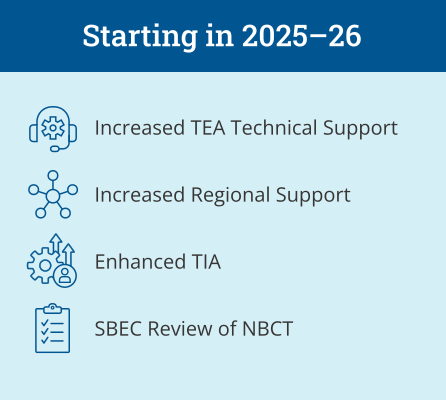
Effective beginning school year 2025-26
- TEA will expand technical assistance and regional support for districts developing and implementing local designation systems.
- Districts begin collecting data for the new Acknowledged level designation.
- The new Enhanced TIA district-level designation and funding becomes available to districts.
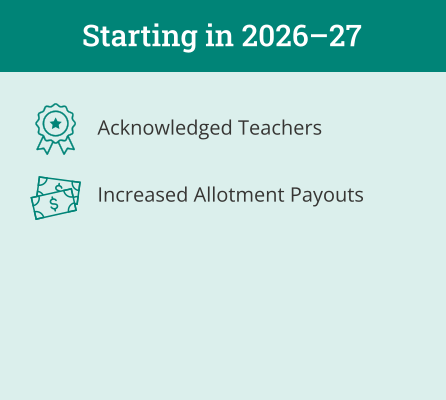
Effective beginning school year 2026-27
- Districts may submit teachers for the new Acknowledged level designation for Fall 2026 Data Submission.
- Districts will see the increased teacher-generated allotments for all designation bands in their FSP payments.
- Following SBEC reauthorization, National Board Certified Teachers with Recognized designation will be redesignated as Nationally Board Certified.
Teacher Designations and Funding
- A new Acknowledged level designation, to align with teachers performing in the top 50% statewide, was added.
- Recognized, Exemplary and Master designations were given an increase to allotment amounts.
- National Board Certified Teachers were given a new designation, Nationally Board Certified, and a review process to monitor alignment of National Board Certification with Texas standards.
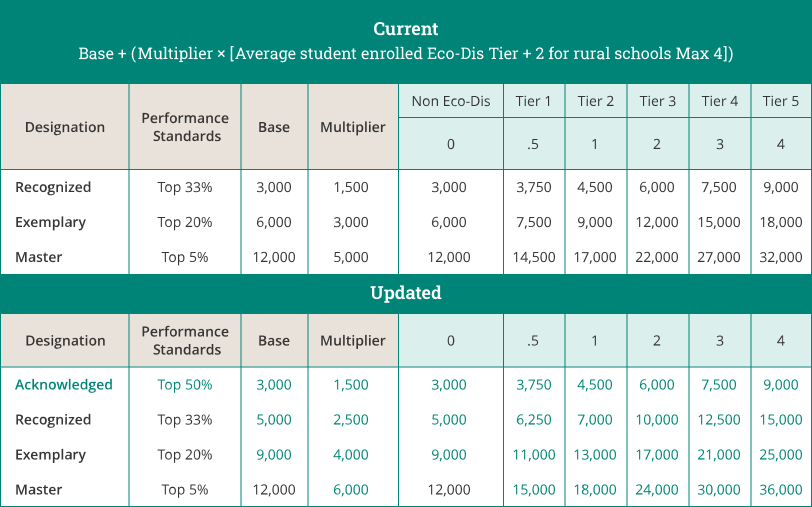
Performance Standards for Acknowledged Designation
Using statewide teacher performance data, the Texas Education Agency (TEA) established objective performance standards to serve as guidelines for districts when evaluating teacher effectiveness and setting designation criteria. These performance standards are based on statewide percentages: Acknowledged represents the top 50% of Texas teachers, Recognized the top 33%, Exemplary the top 20%, and Master the top 5%. Designation rates within a given campus or school system may exceed or fall short of the statewide percentages. This will depend on the effectiveness of the teachers employed and the local designation criteria.
Teacher observation performance standards were determined using statewide T-TESS observation data. Student growth performance standards were determined through a value-added model using STAAR data over a five-year period (2014–2019). Having examined all teacher performance, both through T-TESS observational data and for student growth in STAAR over that five-year period, objective statewide benchmarks were set based on the distribution of teacher performance within that time.
The table below outlines the performance standards required for each designation level. These performance standards will be finalized through Commissioner rulemaking.
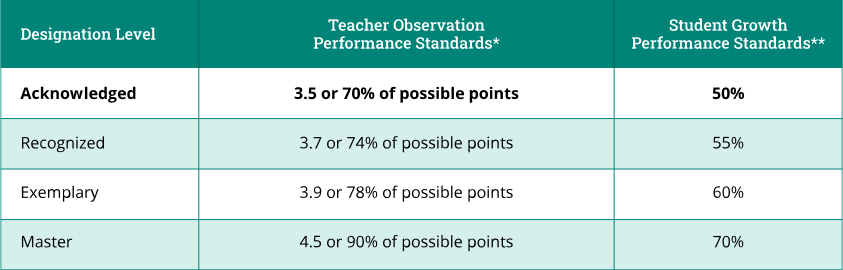
*Represents average of all dimensions in T-TESS Domains 2 and 3. Districts using a rubric other than T-TESS may refer to the percentage of possible points in observable dimensions.
**Represents the percentage of a teacher’s students who met or exceeded the expected growth
Enhanced TIA
Districts may now earn an Enhanced TIA designation that provides a 10% increase to their annual TIA allotment. To earn an Enhanced TIA designation, districts must build evaluation systems and compensation plans for both teachers and principals based on performance.
Enhanced TIA Designation Requirements
For teachers, districts must:
- Include all teacher types as eligible for designation in a TEA approved local teacher designation system for TIA.
- Replace the step and ladder pay scale for a compensation plan based on performance.
- Implement a targeted distribution model & other appropriate quality control systems.
- Adopt an approach to teacher assignment based on student need that includes strategic scheduling for early grades and high needs campuses and students.
For principals and assistant principals, school systems must:
- Develop a refined principal and assistant principal evaluation system consistent with the TIA approach.
- Replace the step and ladder pay scale with a compensation plan based on performance.
FAQs
What is the Enhanced TIA Application Process and Timeline?
Last Updated on September 25, 2025 by ben@connectiveagency.com
TEA has released an online Letter of Intent (LOI) to apply for an Enhanced TIA designation. Districts that either already have local designation systems meeting the Enhanced TIA requirements above or plan to implement such systems for the 2026-27 school year may submit a Letter of Intent in preparation for the Enhanced TIA application in the Spring of 2026.
If this applies to your district, please have your district TIA lead complete the online Enhanced TIA LOI as soon as possible. Districts may preview the full LOI content for planning purposes before submitting. Please note that submissions will only be accepted via the online Qualtrics form.
Districts that submit a Letter of Intent (LOI) will gain access to the Enhanced TIA application, which is expected to go live in late winter. The anticipated due date for this application will align with the TIA application deadline of April 15.
What is strategic compensation, and what is its relationship to Enhanced TIA?
Last Updated on September 25, 2025 by ben@connectiveagency.com
Strategic compensation is a performance-based human resource management technique that involves designing and implementing a compensation plan that is strategically aligned with district objectives and culture.
In Texas, strategic compensation refers to developing a specific plan that allows districts to measure and reward employee effectiveness based on identified characteristics. This definition of effectiveness is then utilized to develop a salary schedule based on performance instead of basing compensation on years of service.
In 2025, the Texas Legislature created Enhanced TIA, a district-level designation for school systems that want to go beyond TIA. Districts can apply for and receive an Enhanced TIA designation after establishing a compensation system based on performance and other requirements. Once obtained, this designation allows districts to receive a 10% increase in their TIA allotment.
What are the implications of House Bill 2 for National Board Certified Teachers?
Last Updated on September 25, 2025 by ben@connectiveagency.com
In 2026-27, National Board Certified Teachers currently designated as Recognized will be redesignated as “Nationally Board Certified”, and a new funding band will take effect. Nationally Board Certified teacher allotments will align with the Acknowledged designation level allotment. National Board Certified teachers will continue to be eligible for all levels of designation under a district local designation system.
To promote alignment with Texas standards and processes, HB 2 also creates a review process for National Board certification to determine future eligibility for TIA.
What is the timeline for the new Acknowledged category and increased payouts?
Last Updated on September 25, 2025 by ben@connectiveagency.com
Districts will be able to propose teachers for the Acknowledged designation in October 2026 using teacher performance data from the 2025-26 school year. To potentially qualify for the new Acknowledged level designation, teachers must have a full appraisal and student growth data in 2025-26.
Districts will receive an increased allotment for Acknowledged teachers and increased payouts in 2026-27.